
Chicory: From Ancient Remedy to Science-Backed Supplement
Chicory, the All-Powerful
Written between 50 and 70 AD, De Materia Medica (“The Medical Materials”) would become the most widely read source of medical knowledge for over 1,500 years, and remains our primary source of information about the medicines used by the Mediterranean cultures of antiquity.

The oldest surviving copy of De Materia Medica was made in the year 512 for Juliana Anicia, daughter of the former Emperor Olybrius.
In the third book of this five volume work, Pedanius Dioscorides, the Greek physician and pharmacologist, wrote of what he referred to as wild and cultivated seris. Wild seris corresponds to what we now call “common chicory,” whereas cultivated seris is now known as “endive”:
Both are astringent, cooling and good for the stomach. Boiled and taken with vinegar they stop discharges of the bowels, and the wild (especially) are best for the stomach, for when eaten they comfort a disturbed and burning stomach. Applied with polenta (or by themselves) they are good for heart conditions. They help gout and inflammation of the eyes. The herb and root are rubbed on to help those who are touched by a scorpion, and with polenta they heal erysipela [streptococcal skin infection]. The juice from them with cerussa [white lead ore] and vinegar is good rubbed on those who need cooling. 1
Around the same time, Pliny the Elder, a military commander and imperial administrator for the Roman emperor Vespasian, was spending sleepless nights writing his Naturalis Historiae (“Natural History”). The largest single work from the Roman Empire to have survived to the modern era, Naturalis Historiae compiles information gleaned from other ancient authors, many of whose works have been entirely lost. It covers topics ranging from astronomy, mathematics, and art to human physiology, botany, and pharmacology.

Depiction of a meeting between the Emperor Vespasian and Pliny the Elder, one of his most trusted advisors.
In the twentieth book of this encyclopaedic text, “Remedies Derived from the Garden Plants”, Pliny wrote the following of common chicory, which he referred to as cichorium:
Wild endive or cichorium has certain refreshing qualities, used as an aliment. Applied by way of liniment, it disperses abscesses, and a decoction of it loosens the bowels. It is also very beneficial to the liver, kidneys, and stomach. A decoction of it in vinegar has the effect of dispelling the pains of strangury; and, taken in honied wine, it is a cure for the jaundice, if unattended with fever. It is beneficial, also, to the bladder [...]
In addition to these qualities, the magi state that persons who rub themselves with the juice of the entire plant, mixed with oil, are sure to find more favour with others, and to obtain with greater facility anything they may desire. This plant, in consequence of its numerous salutary virtues, has been called by some persons "chreston," [“the useful”] and "pancration" [“the all-powerful”] by others.2
Rome’s magi may have been juicing up their sales pitch a bit, but even so, from these two sources we can observe some consistency in the way pre-modern physicians and herbalists employed chicory to treat digestive illness. This is borne out by the use of wild chicory as a tonic for disorders of the digestive system among many systems of traditional medicine, including Ayurveda (where some have identified it with the legendary herb “kaasni”) and Mongolian folk medicine, which would go on to become Traditional Chinese Medicine.
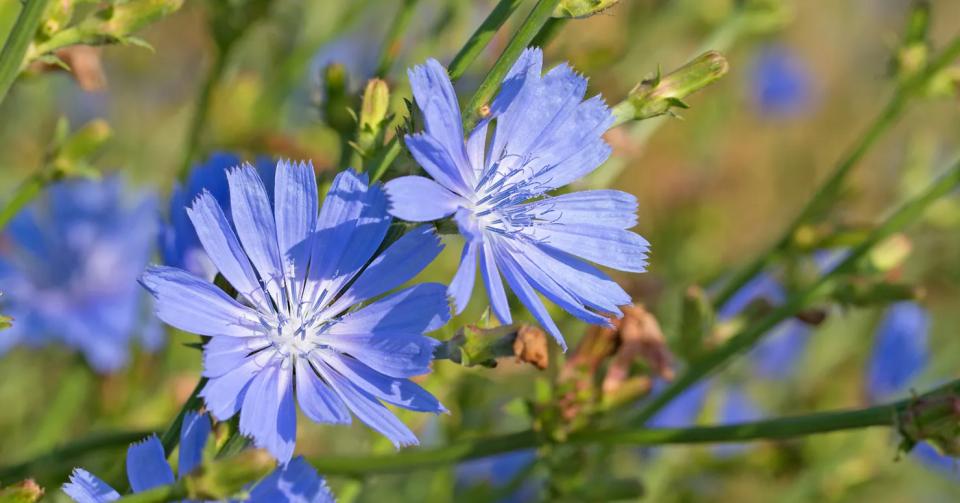
Each of the 'petals' of chicory's radiant blue flowers is actually a complete flower unto itself. A chicory flower head is thus a kind of "super flower" in which individual flowers come together as a larger integrated whole.
Chicory has also frequently been used to treat disorders of the liver. Within the folk medicine systems of both Europe and Asia, foods with an astringent quality and bitter taste were regarded as having a cleansing and beneficial effect on the liver, which, when regulated, would have a soothing effect on the patient’s emotions.
As we will see, all these prescriptions have interesting correlations with the effects of chicory’s component compounds as observed by modern scientific studies.
Chicory the Sidekick
Despite recognition of chicory’s medicinal value in virtually every part of the ancient world in which it was available, this association was gradually displaced due to chicory’s relationship with the most pervasive and beloved drink of modern times: Coffee.
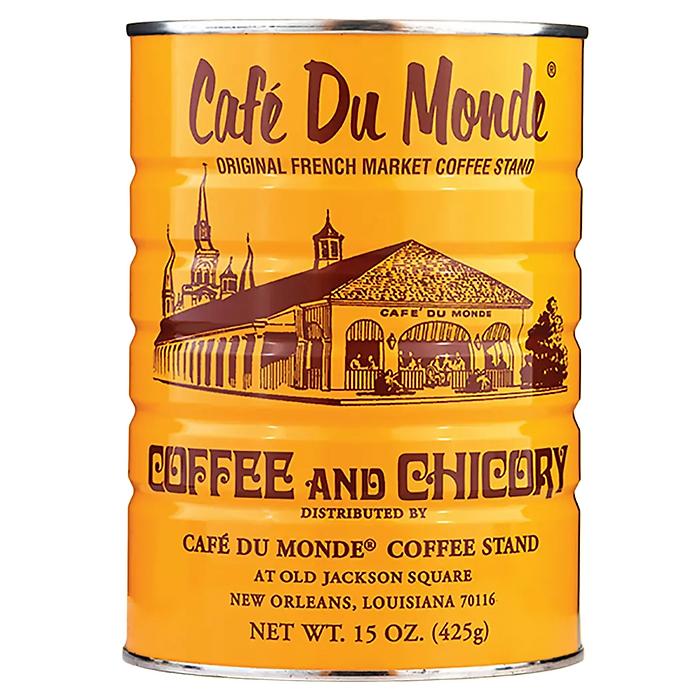
Chicory’s woody, coffee-like flavour led to people using it as a coffee substitute and additive during coffee shortages brought about by trade blockades during the Napoleonic Wars and the American Civil War. This gave birth to modern artisanal blends, such as the chicory coffee sold by Café du Monde in New Orleans since the 1860s, as well as to instant coffee preparations like South Africa’s own Ricoffy, Frisco, and Koffiehuis. In both Europe and the Americas, it would be centuries before chicory’s value to human health would return to the foreground.
Back in Black: Chicory Reclaims the Spotlight

There's some scientific terminology up ahead, but don't stress, the takeaways are straightforward :)
Henri Braconnot, a French chemist and pioneering investigator of mushroom compounds like chitin and glucans, first extracted the compound inulin from chicory in the 1800s. However, it was not until the late 20th century that the benefits of this humble oligosaccharide would regain widespread recognition.
In the 1980s, scientific reports on the bifidogenic properties of inulin began to emerge. Bifidogenic means that these substances specifically enhance the growth of bifidobacteria, organisms that play a critical role in the human gut microbiome. The importance of this group of bacteria had been discovered by researchers who were trying to understand why babies that were not breast-fed were more susceptible to disease. The researchers observed that these infants lacked strong intestinal colonization of bifidobacteria. When it was observed that human breast milk is rich in oligosaccharides, manufacturers began adding chicory-derived inulin to bottled milk formula. The results spoke for themselves.
Clinical studies have demonstrated that these prebiotic formulas have significant effects on flora composition, improve stool consistency, decrease intestinal permeability, and reduce the incidence of gastrointestinal (GI) and respiratory infections and atopic dermatitis. Oligofructose [another term applicable to inulin] in weaning foods consumed by toddlers increases fecal Bifidobacteria counts and decreases fecal Clostridia counts during consumption, leading to softer stools and fewer fever episodes and other GI symptoms.3

"The Chicory Fairy" by Cicely Mary Barker
Chicory the Prebiotic
Dr. Marcel Roberfroid, a Belgian biochemist, is credited with bringing chicory’s health benefits for adults into the limelight. He championed the concept of prebiotics (not to be confused with probiotics), describing them as non-digestible food components that selectively stimulate the growth of one type of beneficial bacteria or group of bacteria in the colon.4 Chicory’s inulin fits perfectly into the definition of a prebiotic.
Over time, inulin has also been found to benefit other gut bacteria, and to contribute to an overall diverse bacterial environment in the gut.5 Diverse gut microbiota have been associated with both a longer lifespan and a longer healthspan, the period of life spent without chronic diseases such as diabetes, Parkinson’s disease, or Alzheimers.6
Some of these effects have been attributed to the increased growth of bacteria that produce short chain fatty acids (SCFAs). These fatty acids, particularly butyrate, propionate, and acetate, play essential roles in maintaining gut health. Butyrate, for instance, is a primary energy source for colonic cells and possesses anti-inflammatory properties. SCFAs also beneficially influence other organ systems and body functions, including appetite, kidney health, and immunity. Inulin can increase the production of SCFAs, thereby promoting a healthy environment within the colon and the rest of the body.7
Chicory is the richest natural source of inulin, and the central role of balancing the gut microbiome in human health means that consuming chicory can have knock-on effects throughout your body. Starting to wonder if maybe the Romans weren’t so far off when they called it “the all-powerful”?
Beyond Inulin
Chicory also contains many other beneficial compounds, some of which researchers are just beginning to understand. Here are six more benefits to consuming this long-forgotten root.
- Support for Liver Health Some animal studies have backed up traditional claims about chicory’s impact on liver health, showing that chicory extracts can counteract oxidative stress in the liver and might play a protective role against hepatotoxic (liver-damaging) agents.8
- Anti-inflammatory Properties Chicory contains several bioactive compounds with potential anti-inflammatory effects, including flavonoids, sterols, glycosides, tannins, and terpenoids.9,10 Studies in animal models have shown that chicory root extracts can reduce inflammatory markers, suggesting that it has potential applications in managing inflammation-related disorders.11
- Antioxidant Properties Free radicals in the body can cause cellular damage, leading to various diseases. Chicory root is rich in polyphenols, which possess antioxidant properties, scavenging free radicals and protecting cells from oxidative damage.12
- Anti-carcinogenic Properties Emerging research suggests that chicory contains compounds that inhibit tumor growth. In vitro studies have demonstrated the anti-proliferative effects of chicory extract on cancer cells. 13
- Bone Health Studies have shown increased calcium absorption and improved bone mineral density in rats fed with inulin.14
- Potential Impact on Anxiety and Mood While there are few studies to back up traditional medicine’s claims about the mood-improving and anxiety-reducing effects of chicory, these effects can be inferred from its anti-inflammatory and gut-health-promoting properties. We now know that generalised anxiety is often associated with low-grade chronic inflammation, and treating inflammation can have as much effect on depression and anxiety as antidepressants or anxiolytics.15, 16 At the same time, the health of the neurons that line our guts is now understood to impact mood, cognitive function, and behaviour to the extent that medical experts refer to it as “the second brain”.17 Intestinal permeability has even been proposed as the root cause behind the chronic low-grade inflammation generally present in stress-related psychiatric disorders.18 So consuming a substance known to both reduce inflammation and enhance gut health will logically have spillover effects that can lead to improved mental and emotional wellbeing.
Nuff Said?
While more research is always beneficial, current scientific findings make a compelling case for considering chicory as part of a balanced and health-conscious diet. This plant medicine, with a history of safe use stretching back into the mists of time, is also quite delicious, and really hits the spot in the evening when downing another cup of coffee would keep you up all night. Try using Ancient Roots Chicory to make a quick instant beverage, or get fancy with your mokapot to make a delicious caffeine-free version of your favourite espresso-based drink.